Art and design projects. With stories about the people, places and experiences that have shaped my

Showing posts with label Provincetown. Show all posts

Friday, July 31, 2015

My New Book: 'Robert Motherwell, In the Studio'


By John E. Scofield

Published by Bernard Jacobson Gallery

In 1975, in the midst of a series of European retrospectives, Robert Motherwell (1915–91) hired a young man named John E. Scofield to be his first full-time studio assistant. Now, in honor of Motherwell’s centenary, Scofield—an artist and designer himself—has written a poignant and tender memoir which conveys the life and thought of a leader of the Abstract Expressionist school a generation ago. Intensely personal, the narrative brings the 1970s to life: Scofield writes of art, intellectual conversation, road trips and male bonding with affection and honesty. Robert Motherwell: In the Studio discusses the booze they preferred, the cars he drove, the artists he admired and the New York art scene that swirled around him. Well told and evocative, this page-turner offers a unique insight into a pivotal figure of American painting.


Notices and events: 

In the Studio is now available in the USA Through the New York art book publisher D.A.P.
http://www.artbook.com/9781872784564.html

~ Television anchorwoman Ann Nyberg recently included this book in an interview with me on 'News8' WTNH in New Haven, CT:
http://networkconnecticut.com/2015/08/john-everett-scofields-award-winning-music-stand/

~ Kent, CT: Saturday, 21 November 2015 book talk and signing accompanied by a slide show at the Kent Memorial Library, Kent, CT.
http://www.kentmemoriallibrary.org/
32 North Main Street, PO Box 127 Kent, CT 06757
860.927.3761
Hours: M-F 10-5:30, Sat 10-4

 
'Robert Motherwell, In the Studio' by John E. Scofield, 2015, front and rear of jacket.
I started writing Robert Motherwell In the Studio in 1995 as an essay on crafts and art. Since then it has slowly developed into a story about my years with the late Abstract Expressionist painter Robert Motherwell. Just published by the Bernard Jacobson Gallery in London, it is now available on Amazon UK. Below are edited excerpts from the book. You might call it a love story - but without the fights...

On New Year's Eve, in December of 1972,  Bob Motherwell and I met for the first time over drinks in the apartment above his Connecticut studio. We talked about a lot of things including the not terribly clear relationship between the crafted functional object and fine art. He was 57. I was 22.

As Motherwell patiently listened to my story of the craft troubles, he was also reading the messenger like a book - with a very good understanding of the way a young student carries a burning issue around him like a weight. I finally produced a few color slides of my own student work. After a very brief look he put them down and it seemed like it was time to pay more attention to his family.

To sum up his feelings on all the issues I had presented he said to me, "Due to functional limitations, the crafted object can never express the human condition, through metaphor, as well as high art can."

This started a friendship and working relationship that lasted until his death in 1991. I ended up working full-time for him from 1975 to '78. The wrap-around jacket photo above shows us painting 'Reconciliation Elegy,' a 31 foot long and ten foot high commission for the East Wing of the National Gallery in Washington, D.C.


'Colored Chair,' 1971, carved and painted wood, shown in a corner of the 2nd floor library.
Some months after our first meeting he purchased my sculptural, “Colored Chair,” For the chair's back I had carved a big chunk of wood from an enormous Bucks County cherry tree. The base was poplar wood stained dark green and flocked in a bright orange color. He said, “You know, it looks like a Miro sculpture.” I was so naïve that I had to pretend I knew who Miro was! 
But the next day I made it my business to find out. This was the beginning of keeping up to speed with the boss; reading, seeing, thinking and doing. You had to be quick on the uptake or you were dead. That's a Matisse collage sitting on the floor in the lower right of the photo. Motherwell did not own a lot of works by other artists. He had an Arp relief, a Cornell box, a Max Ernst sculpture and a few other nice things that were special to him.

Motherwell's painting for Chateau Mouton Rothschild's 1974 label.
One day Baron Philippe de Rothschild called to tell Motherwell that the Baron's wife had just died. Beside her deathbed, on a table, was the small painting maquette we had made for the label. He said that it had been of great consolation to her during her last hours on Earth. Considering the strain he was under, it's remarkable that he was so polite when I, the studio assistant, answered his call. Few callers were so courteous.

In the summers Motherwell normally worked without assistants up in the third floor of ‘Sea Barn,’ his Provincetown house. But in the spring and summer of 1977 he brought me to P’town to help with some special projects. After work and on weekends I often went fishing for bluefish and striped bass.

Late afternoon fishing from the boat with Jeannie on Cape Cod Bay, 1977. I caught a flounder by accident using this deep-diving lure. If we caught blues at night, then I would fillet them; leave some wrapped in newspaper on the front step of Sea Barn as a morning present. I would normally work all day then fish at night. Thermos of espresso on the dash, running lights on, prop churning up green phosphorescence. Come back in before dawn. When keeping this sort of schedule up it helps to be twenty seven…     Photo: Jeannie Motherwell


The following fall and winter were largely devoted to preparing and executing 'Reconciliation Elegy.

Applying gesso to the raw canvas for ‘Reconciliation Elegy.’ Motherwell is shown here standing in front of his downstairs library in the big painting studio. He always recommended books that had been important to him; encouraged us to borrow them. L-R: Scofield, Bigelow, Motherwell.
Photo: Renate Ponsold Motherwell


Here are some additional photos that are not in the book:


My 'chest of drawer' / table with a Joseph Cornell 'box' sitting on top. This was in the 2nd floor
dining / sitting alcove. That room had beautiful light in the sunny late afternoon.


The chest / table is mahogany and carved pear-wood.
My 'Colored Chair' in the apartment sitting area. It got moved around from time to time but
usually sat in the little library by the stairs - where it remained for the better part of 17 years. 
One night we sat on that leather couch watching TV as Jimmy Carter got elected - while
eating Bob's roast chicken with herbs. 


Noted filmmaker Stephan Chodorov recently wrote this brief review of the book:

How often do we read "inside" scoops on the behavior and misbehavior of the successful and celebrated which serve only to boast that the insider had their confidence. So how refreshing it is to have a book like this which reports in an unpretentious way the life and thought of a leader of the Abstract Expressionist school a generation ago. I should say "lives and thoughts" because the writer himself is in the picture throughout, first as an aspiring student with barely two nickels to rub together, and eventually as Robert Motherwell's indispensable assistant. The booze they preferred, the cars they drove, the painters they admired, and the history that swirled around them -- it's all in this neat little book with fascinating photographs. It's to Scofield's credit that he knew how much space to put between himself and the master, and that he knew, as he says, "when it was time to go." Motherwell went on to participate in the rise and fall (and rise again?) of Abstract art...Scofield went on to study sculpture, painting and furniture design (one of his pieces is in the Museum of Modern Art collection).

And Tony Scholl had this to say:

"Scofield's years with Motherwell... a boldly intellectual yet friendly look at a fascinating time and relationship."


Verified Purchase
Poignant and tender, Scofield's memoir is not simply about his time as Robert Motherwell's assistant -- interesting as that is. It is an homage to a time when the art world was evolving -- and to a relationship that shaped and influenced a young man. Well told and evocative, it leaves you wanting more.

Verified Purchase
The Seventies come to life in this fine book full of art, intellectual conversation, road trips and male bonding. Scofield's relationship with Motherwell was a rare thing, an apprenticeship to a good man who understood him. Scofield writes with affection and honesty. An engaging, well-told story.


By hugh davies on 30 Oct. 2015

Verified Purchase
This is a fascinating first hand account of life in the studio of Abstract Expressionist master, Robert Motherwell. Scofield's recollection of everything from studio practice and the artist's reading habits to the frequent visits of art world celebrities is a lively and personally evocative history of one of our greatest artists. A must read for scholars and art lovers alike.
Hugh Davies, Director, Museum of Contemporary Art San Diego

My book can be purchased through these links:

http://www.artbook.com/9781872784564.html

http://www.amazon.co.uk/Robert-Motherwell-In-The-Studio/dp/1872784569/ref=cm_cr-mr-title

~~~
Another new, very engaging book on Motherwell and his fellow Ab-Ex artists is the one Bernard Jacobson has spent the last two years writing. It is titled, Robert Motherwell: The Making of an American Giant. Bernard put his heart and soul into this. We both did...!

http://www.amazon.co.uk/Robert-Motherwell-Making-American-Giant/dp/1901785157/ref=aag_m_pw_dp?ie=UTF8&m=A2KELR7V6FL47K

All photos and text on this blog site are 'Copyright John E. Scofield 2015.'


Saturday, July 14, 2012

Robert Motherwell in Provincetown, MA and Greenwich, CT


In 1977 I spent the late spring, summer and early fall working for Robert Motherwell in Provincetown, MA. I would work for him all day, then fish for striped bass and blues all night. You have to be 27 years old to keep that sort of schedule up. We worked hard, created a lot of art and had a lot of fun doing it. The late art historian Sam Hunter once told me that working for Bob, "... was better than going to any graduate school." That was probably true. He died in 1991 when my son Jackson was an infant. There was a big memorial service on the beach with hundreds of people. I still miss the guy very much.


Me holding 'Reconciliation Elegy' up vertically for the first
time at the National Gallery, Washington, D.C.
Photo: Bob Bigelow

His main studio was in Greenwich, CT, where we created the painting 'Reconciliation Elegy,' shown below, in 1978:
RM in foreground working the edges in black. The canvas is 31 feet by 10 feet.
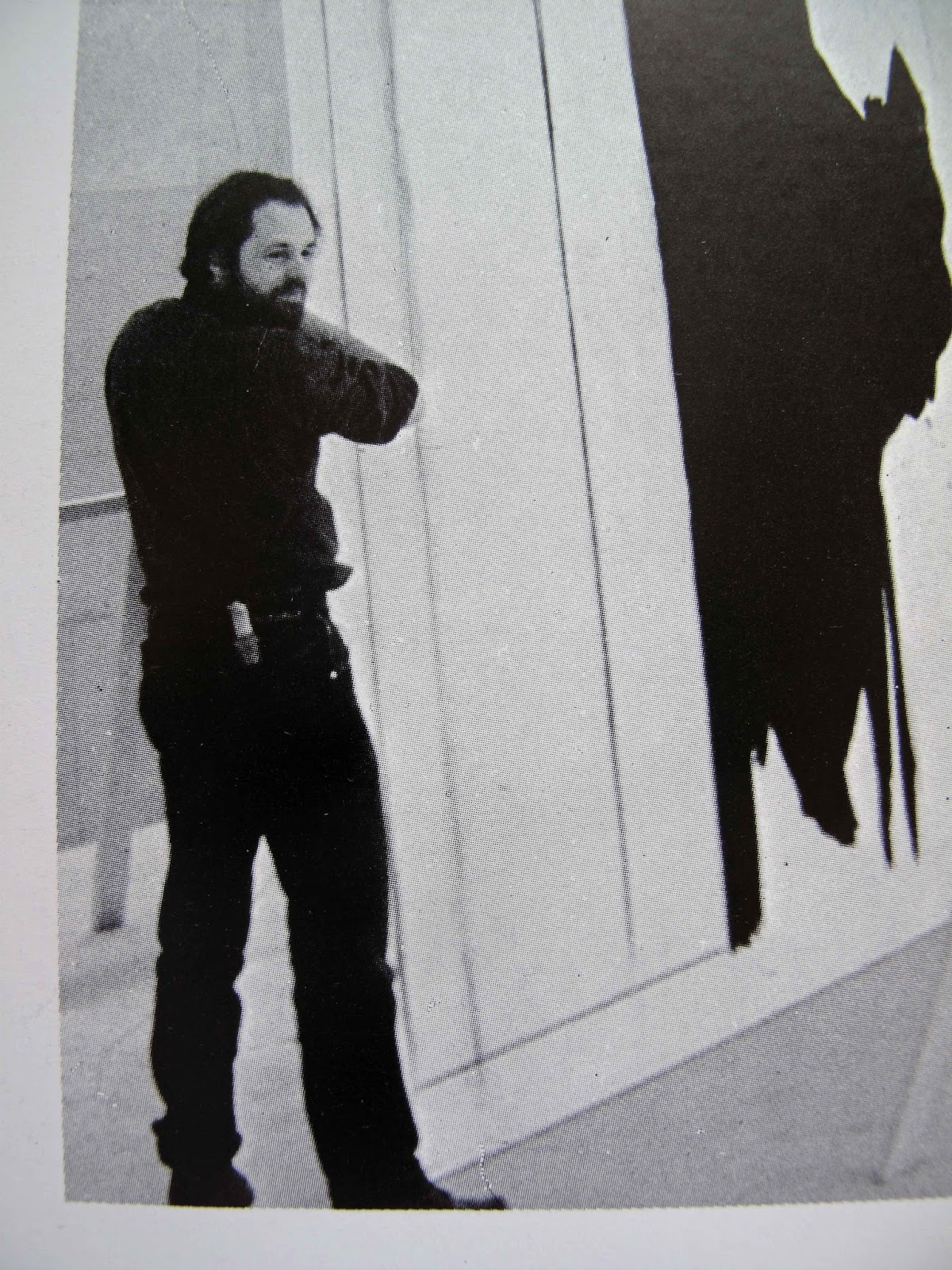
Motherwell (foreground in black shirt) with me standing behind him. On the back wall is an intermediary line shot (blow-up) of the original maquette. I removed the wood handles on Bob's favorite brushes. Then I made and installed new ones that were one meter long. That's what he is holding in this photo. He is applying black acrylic paint to re-work edges. Bob Bigelow and I filled in the large sections. He did not follow our chalk lines faithfully, which was a little vexing. He worked somewhat like a jazz musician; using the chalk lines loosely; more as a jumping off point. (Anyone who studies the maquette and the big painting will see lots of changes from the original). And he liked the way the red chalk mixed into the paint and became a pink highlight.

Bob Bigelow (at left) and I are making the full-size cartoon.

Bob Bigelow (left in striped shirt) and I are shown 'pouncing' chalk through a big piece of paper (the cartoon) on to the canvas below. The paper was perforated with thousands of tiny holes. In the end you got an image of a thin, red dotted line on the canvas. This canvas was so big - 31 feet long - that it was impossible to tell where you were (where the image was going to be) when walking on it. You needed the chalk lines for guidance.

This painting is now on permanent display at the National Gallery in Washington, DC. Skira-Rizzoli published a book about how we made it: http://www.amazon.com/Reconciliation-Elegy-Robert-Motherwell/dp/0847803368

For years afterward Hilton Kramer often felt compelled to tell me that he hated the picture. But that was his problem. Bottom line for me now that I am a lot older but perhaps only a little wiser: At the time, in 1978, I thought that we could have done it better; should have been more faithful to the original maquette etc. Now, in 2015, I think it's amazing that the picture came out as well as it did; has held up so well. We did it the boss's way. And he was right! 


Fishing from the boat, Provincetown 1977.
Photo: Jeannie Motherwell
In the Greenwich Studio, '70s.
Still carrying the torch for: The structure of modernism, abstraction, truth to materials, automatism, expression of a block of values, authenticity, poetic quality, western tradition, innovation, depth of feeling - for over forty years.

~~~~


In the '70s master lithographer Bob Bigelow and I tried to bring our boss up to speed with regard to acid-free materials etc. We got a lot of professional conservation products - glues, rice-paper hinges, silicone release papers - from a place called Talas in lower Manhattan. But our technical sophistication then has, by now, been eclipsed several times over. We were at cave-man level 'tech-wise' compared to what's out there now.

Last year, in 2014, I found out that Motherwell made a very large collage with a ripped Talas shipping label in it; addressed to me. That's really nice. It's titled 'Talas.' He would have been 100 this year. The above photo detail is from Jack Flam's excellent Catalog Raisonne on Bob's life and work.
~~~~
Taking my shoes off to walk on the painting. 
The air hose and regulator hanging on the wall to my left were for spraying a final clear-coat of acrylic varnish on Reconciliation Elegy. He wanted it really matte, "...like a watercolor." And that's what we gave him. I'm shown sitting on a narrow 'ledge' made for getting pictures in progress up off of the floor.

Here's one example of how we got things done without a lot of meetings or fuss: Bob M wanted me to build the ledge out of a fine, furniture-grade wood. I did not like that idea. So, when he was out of town for a couple of days I built the more basic design shown above instead; about 75 linear feet of it covering both sides of the room. It's metal base is made out of a British angle-iron product I liked called Dexion. The foot-deep plywood top surface was then painted the same color as the floor. Visually it thus became almost invisible; not a distraction. Bob returned home from his trip and said nothing. We started using it immediately. 
~~~~

These are publications on Motherwell in which I am either an author, contributor or mentioned:


Robert Motherwell: In The Studio Paperback – 2015

http://www.amazon.co.uk/Robert-Motherwell-In-The-Studio/dp/1872784569/ref=cm_cr-mr-title


My own illustrated book on Motherwell describes the three years I worked for him and other stories. 

Excerpts from Robert Motherwell: In the Studio:

"Abstract Expressionism has been called an exploration of the sub-conscious. And Ab-Ex subject matter has been described as an essence, a distillation of the artist’s personal identity. In my view Motherwell’s ‘explorer identity’ ruled everything. Discover a new subject. Approach an old subject in a new way. Use a new color. Use a new combination of colors. Every picture held the possibility of being the best; saying the most. On good days this excitement was infectious to the rest of us who had art training; me, Cathy Mousley, Bob Bigelow, Betty Fiske. It was like we were on some sort of artistic Lewis and Clark expedition. A corps of aesthetic and emotional discovery. The contiguous studios often felt like a ship of many rooms on a voyage."

"Was every day with Bob filled with rapturous poetic revelation; literary connection; powerful atavistic conviction? No. There could be combat too. Some star-struck visitors walked around the studios looking like they were floating between different movies – a fantasy. Say, ‘The Agony and the Ecstasy’ meets ‘Roman Holiday.’ Reality was more like the angst and storm of ‘Pollock’ meets the live fire of ‘Twelve O’clock High.’ We had plenty of difficulties within and without; both artistic and what are now called ‘people problems.’ Bob had enemies. Today, writing this account forty years after the fact, I’m inclined to want to use the Photoshop erasure brush on a lot of it. Or at least one of those fuzzy watercolor app iPhone filters. Jeannie Motherwell calls those days, “…when you worked for Dad.” When I read those words it makes me feel a great sadness and nostalgia for a wonderful time that has come and gone. I still think of Jeannie and her sister Lise with tremendous affection. Well, before getting too weepy I’d better continue telling this story."

By hugh davies on 30 Oct. 2015
Verified Purchase
This is a fascinating first hand account of life in the studio of Abstract Expressionist master, Robert Motherwell. Scofield's recollection of everything from studio practice and the artist's reading habits to the frequent visits of art world celebrities is a lively and personally evocative history of one of our greatest artists. A must read for scholars and art lovers alike.
Hugh Davies, Director, Museum of Contemporary Art San Diego.
Verified Purchase
The Seventies come to life in this fine book full of art, intellectual conversation, road trips and male bonding. Scofield's relationship with Motherwell was a rare thing, an apprenticeship to a good man who understood him. Scofield writes with affection and honesty. An engaging, well-told story.
Verified Purchase
Poignant and tender, Scofield's memoir is not simply about his time as Robert Motherwell's assistant -- interesting as that is. It is an homage to a time when the art world was evolving -- and to a relationship that shaped and influenced a young man. Well told and evocative, it leaves you wanting more.
~~~~

This is the copy that Skira sent me from Geneva.

Reconciliation Elegy

Robert Motherwell, E.A. Carmean Jr., Robert Bigelow and John E. Scofield

Skira & Rizzoli, 1980. A record of the collaboration between Motherwell and his studio assistants to create a massive commission for the National Gallery of Art in Washington.
This book is long out of print but may be available on Amazon, Abebooks and other used book web sites.

~~~~

There is a new, exhaustive three volume, 1,700 page Catalog Raisonne on Motherwell by Jack Flam. It took twenty years to compile and publish. The books come in a very handsome slipcase and the entire business weighs an absolute ton. Jack did a beautiful job on it:

Robert Motherwell Paintings and Collages, A Catalogue Raisonné, 1941-1991

http://yalepress.yale.edu/yupbooks/book.asp?isbn=9780300149159
~~~~

2015 is the centennial of Bob Motherwell's birth. The Provincetown Art Association and Museum is observing it with exhibitions and talks from May 15 - 31:

http://www.fawc.org/events/2015/motherwell/motherwell.php

~~~~

Current and Past Important Motherwell Exhibitions:


DOMINIQUE LÉVY GALLERY
Beginning November 4, 2015, Dominique Lévy in New York will present Robert Motherwell: Elegy to the Spanish Republic, the first gallery exhibition in over twenty years to offer a fresh survey of the monumental series that marked a pivotal moment in the history of modern art. Begun in 1948, Motherwell’s Elegies were intended as public laments, deeply political in their condemnation of the violence of the Spanish Civil War and the isolationist fascism of General Francisco Franco. The artist also described them as “general metaphors of the contrast between life and death, and their interrelation.”

909 MADISON AVENUE
NEW YORK, NY 10021
OPEN: TUESDAY TO SATURDAY 10:00 AM – 6:00 PM AND BY APPOINTMENT


Another handsome 2015 RM exhibition was at Andrea Rosen in Chelsea. 'Robert Motherwell: Opens'

May 1 – June 20, 2015, 
  • 525 W 24th Street, New York, NY 10011
  •  
  • T (212) 627-6000
  • On a delightful spring day Bernard Jacobson and I were gallery hopping in Chelsea and stopped in to see this show. We were met by the Rosen Gallery media and press specialist Laila Pedro. Here we all are in the photo below standing in front of Motherwell's 1968 painting, 'Open #22 in Charcoal with White.' It was a very happy afternoon. 

    Bernard's gallery in London has perhaps the largest inventory of RM paintings in the World. He passionately believes that Motherwell was the greatest of all the first-generation Abstract Expressionists. And he outlines his case with unusual zest, depth and intelligence in this just-released book: 

    Robert Motherwell - The Making of an American Giant 
    by Bernard Jacobson, 2015 
    21 publishing Ltd.
    28 Duke Street St. James, London
    020 7734 3431
    info@21publishing.com

    To my mind the most important passage in it is this one on page 57: 

    "...automatism was not a style, in the sense of an imitation of European styles, but an original unifying principle..." 

    Few in the general public ever consider distinctions like this. It's been an insider's issue.

    L-R: John Scofield, Laila Pedro, Bernard Jacobson. 
    Laila is now the editor of The Brooklyn Rail, a serious, critical arts periodical.

    ~~~~

    A previous 2012 Exhibition in Provincetown was:

    Robert Motherwell:
    'Beside the Sea' On view: July 20-September 30, 2012
    Opening reception: Friday, July 20, 8-10pm


    Robert Motherwell: Beside the Sea, curated by Lise Motherwell and Dan Ranalli, will present rare work created by the artist in his Provincetown studio during the summer of 1962 until his death in 1991.

    2012 is a milestone year as it marks the 70th anniversary of the artist’s first visit to Provincetown, Massachusetts and the 50th anniversary of the creation of his Beside the Sea series, based on his experiences living in the small outer Cape Cod town. This is the first major exhibition of Motherwell’s work on Cape Cod and provides a never before-seen look at many pieces held in private collections.